We are witnessing the birth of neutrino astronomy, a new way to study extreme astrophysical environments such as supernovae, active galactic nuclei, and gamma-ray bursts. Particles are accelerated to tremendous energies in environments like these, and are detected at Earth as cosmic rays. Wherever cosmic rays are accelerated, neutrinos and gamma-rays are bound to be produced through their interaction with the environment. Cosmic rays are then deflected by magnetic fields on their way to Earth, while neutrinos and gamma-rays can travel undeflected. However, neutrinos are the only ones that can travel unhindered over cosmological distances. Gamma-rays of energies larger than a few hundred TeV lose their energy in distances smaller than the size of our galaxy. This is one of the reasons why neutrinos can be the key to understand the origin of the cosmic rays at the highest energies. If we detect an extraterrestrial neutrino, we can point back to its source. Fortunately for us, we now have evidence for extraterrestrial neutrinos detected with the IceCube detector at the South Pole.
In 2015 I developed Monte Carlo simulations to estimate the feasibility of an air shower array to detect neutrinos. I was one of the proponents to enhance the IceCube observatory in the way depicted in the figure.
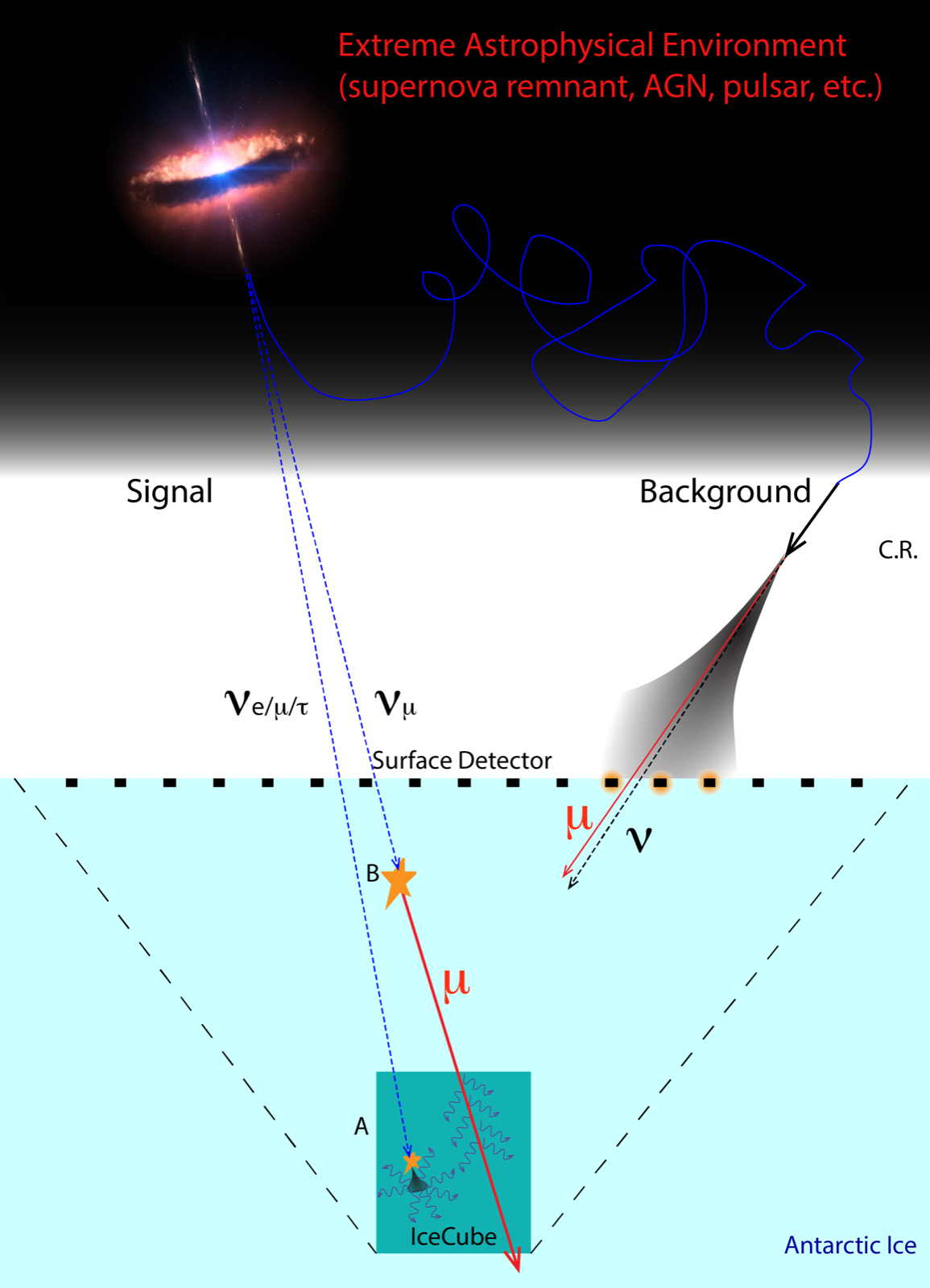
The Analysis
This analysis was published as a conference proceeding: Simulation Studies for a Surface Veto Array to Identify Astrophysical Neutrinos at the South Pole.
The two figures below are the core result: how much of the cosmic-ray background survives the veto, as a function of energy.
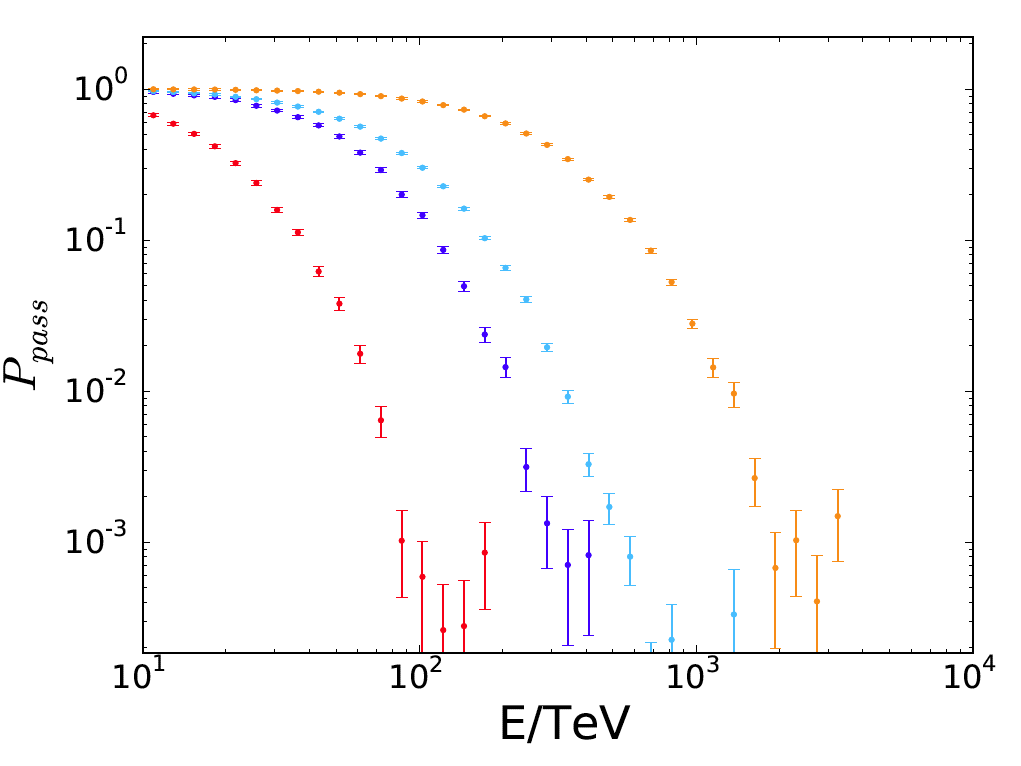
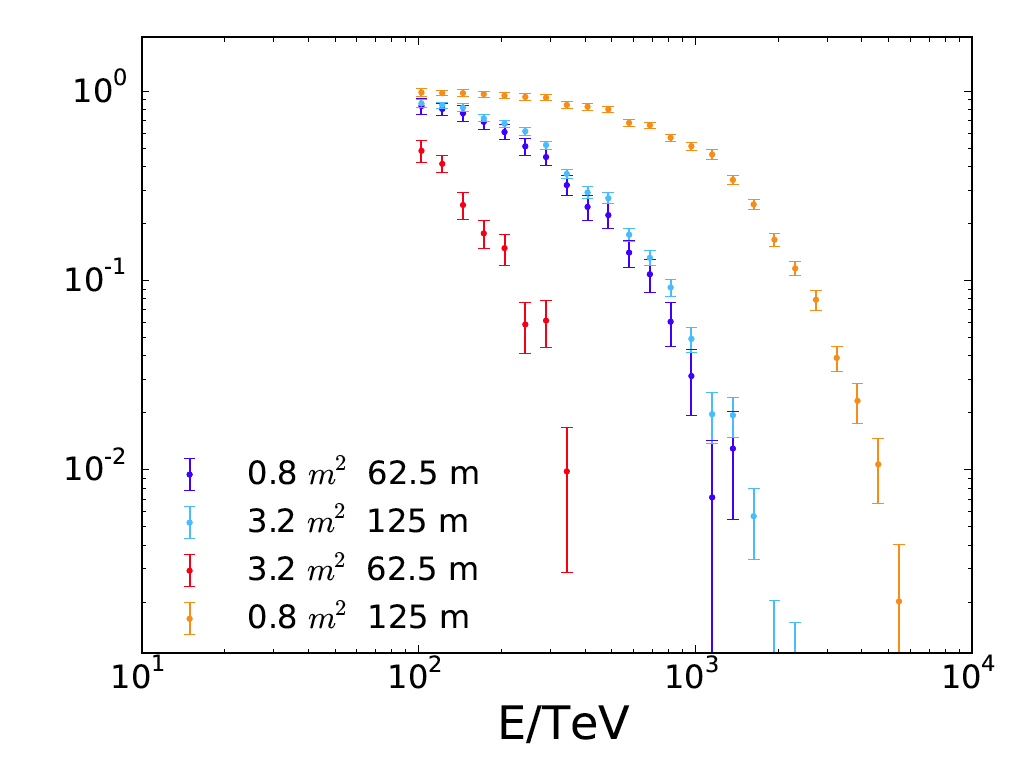
The probability that a background event passes the veto falls steeply with energy: the more energetic the cosmic ray, the more likely its air shower is detected at the surface, and the more reliably the event is rejected. The four series trade detector area against station spacing — 0.8 or 3.2 m² per station, at 62.5 or 125 m apart.
The pair in the middle is key. Those two configurations — 0.8 m² at 62.5 m, and 3.2 m² at 125 m — have exactly the same fractional ground coverage. For inclined showers, their curves lie on top of each other. Four times the scintillator at twice the spacing buys nothing. Vertical showers are a different story, a denser array of smaller detectors catches more of the background. This is caused by the small footprint of electromagnetic showers.
What happened since
August 2026. The short version: IceCube-Gen2 has not been built yet, but the surface detector this work argued for is being installed at the South Pole, and a Gen2 prototype station is running in Argentina:
The IceCube Surface Array Enhancement — being built now. This is the direct descendant of the veto concept: 32 stations inside the existing IceTop footprint, each with eight scintillation panels, three radio antennas and a central fieldhub for data acquisition. A fully functional prototype station ran at the South Pole from January 2020 to December 2022; the first production station was deployed in January 2023; and as of the 2024 status report a quarter of the planned stations had been produced. Its stated goals include exactly what this article proposed — a lower energy threshold, more efficient veto capability, better mass composition measurement, and compensating for snow accumulation over the existing tanks.
The IceCube Upgrade — in the ice this season. The low-energy extension deep in the detector is being installed in the 2025/2026 season; as of January 2026, four of its seven holes had been drilled.
IceCube-Gen2. The Technical Design Report is complete and the project is past conceptual design, but construction is not funded yet: roughly $350M and eight to ten years, scheduled to begin about three years after the Upgrade is finished, with partial operations six years into construction. Gen2's surface array as designed covers about 8 km² with elevated scintillator panels and SKALA v2 radio antennas spanning 70–350 MHz, for a threshold near 0.5 PeV — the scintillators supply the low threshold, the antennas the composition sensitivity above 100 PeV.
The prototype in Argentina. A Gen2 surface array prototype station was deployed at the Pierre Auger Observatory in July 2025, inside Auger's dense 433 m in-fill array, so the radio technique can be checked against water-Cherenkov detectors and the two experiments' energy scales cross-calibrated. That same month Gen2 was shortlisted in Germany's research infrastructure prioritization.
So the instrument exists, in prototype and early production, at the Pole. The 8 km² version waits on money.